
An established platform is often suitable for standard online selling and a quicker start. Bespoke development becomes useful when your business needs unusual rules, integrations or buying journeys. Compare the whole operation, not just the design.
Shopify, WooCommerce, Shoptet and bespoke systems can all be appropriate in different situations. For a UK project, we first check the required payment providers, delivery services, product structure and back-office systems. A platform familiar in another market should not be assumed to fit your business without that review.
What does bespoke ecommerce mean?
A custom design on an existing platform is not the same as building an entire commerce engine. Bespoke work may mean a specific integration, module or checkout rule. A clear proposal distinguishes standard platform features from custom development.
Comparing the options
| Application type | Best suited to | Things to consider |
|---|---|---|
| Shopify | A hosted shop using the platform’s ecosystem. | Ongoing fees, required apps, payment options and checkout customisation limits. |
| WooCommerce | WordPress projects needing flexible content and custom work. | Hosting, security, updates and extension compatibility. |
| Shoptet | Standard retail where the required market integrations are supported. | Verify UK payment, delivery and operational requirements before choosing it. |
| Bespoke system | Specialist workflows and complex integrations. | Dedicated development, testing and long-term maintenance. |
When to choose a hosted platform
A hosted platform can reduce some infrastructure work and provide a practical starting point. It does not remove the need to plan content, delivery, payments and integrations. Confirm the functions you need in the relevant plan and include recurring app costs in your comparison.
When WooCommerce is a useful option
WooCommerce gives room for custom work and connects commerce with WordPress content. That flexibility brings responsibilities: hosting, updates, security and compatibility need an owner. A free software foundation does not mean a free shop to build or operate.
When a standard checkout is not enough
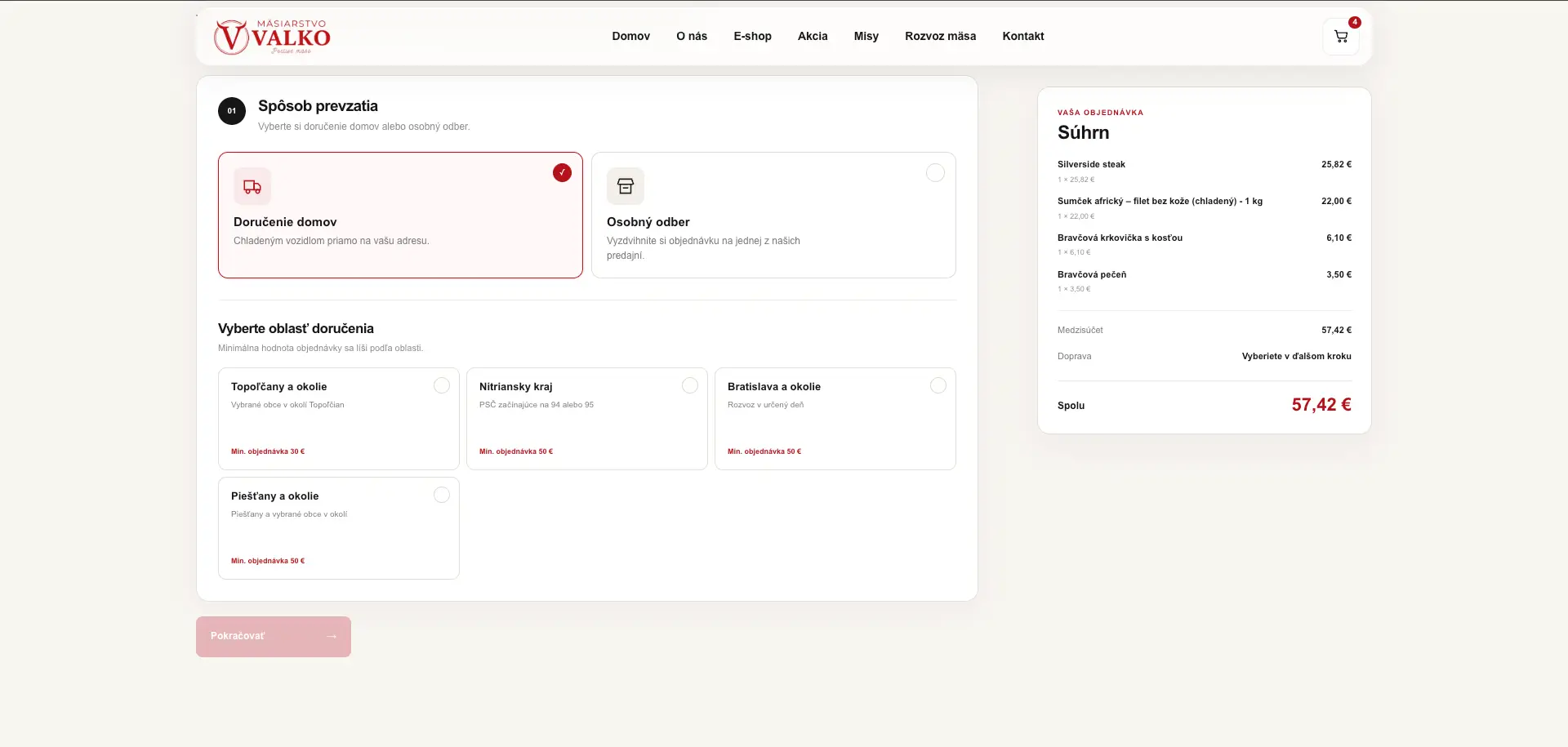
For Mäsiarstvo Valko, the buying journey depended on regional delivery rules. The project needed precise ordering and delivery logic. It demonstrates why platform selection starts with how the business works, not only a visual reference.
Compare total costs
- Design, content preparation, implementation and data migration.
- Hosting or platform subscriptions, paid extensions and external services.
- Inventory, accounting, delivery and payment integrations.
- Maintenance, updates, support and further development.
Compare the same scope over a meaningful operating period. Platform prices and terms change, so we verify the relevant costs when preparing a proposal.
SEO and platform migration
A migration needs a plan for valuable URLs, redirects, content, metadata and indexability. Changing technology does not automatically improve rankings. Category structures, filtering and product content must also work for customers and search engines.
How to choose your platform
List essential functions, catalogue size and planned integrations. Highlight the processes that differ from a standard shop. We can then compare options against those requirements and recommend a practical starting point with room for realistic growth.
Frequently asked questions
Is bespoke development always better?
No. If an established platform meets your requirements well, it may be the more practical and cost-effective choice.
Can a hosted shop have its own design?
Yes, but the extent of customisation depends on the platform, plan and implementation.
Does moving platforms improve SEO automatically?
No. Content, technical execution and a well-managed migration are what matter.
Sources
This article draws on the sources listed and the experience of the FYstart digital studio.